
Art or Commentary? Four Days at the Venice Biennale 2026

Updated: Jul 6
La Biennale di Venezia: 61st International Art Exhibition — In Minor Keys
A first-time visitor to the Venice Biennale finds less of the art she expected and more of the world she already knows — its fractures, its urgencies, and its unresolved reckonings.
By Sorina I. Crisan – Matthey de l'Endroit, PhD | Persuasive Discourse | Opinion | Issue #59
I took the train from Geneva to Venice — a change in Zurich, another in Milan — and somewhere between the last station and the city itself, the train felt as though it were gliding on water. When I stepped out of Santa Lucia station and saw Venice, the sight stopped me in my tracks. A wide canal separated the station from the old town, the light was extraordinary, and I understood immediately that this was not a city you moved through — it was a city that moved through you. I walked to my hotel, slowly, stopping constantly to photograph what I could not quite believe I was seeing. It took much longer than expected. I did not mind.
Over the next four days — from Wednesday, June 17 to Saturday, June 20, 2026 — I visited not only the Biennale but many other museums, galleries, and exhibitions scattered across a city that is itself, as the cliché goes, a living museum. The heat was almost unbearable. And yet the exhibitions were worth every step, every liter of water, and every degree of discomfort. The Arsenale alone — a vast former naval complex with soaring brick ceilings, dim light, and enormous pillars — could absorb an entire day. The Giardini held the national pavilions. And art was everywhere in between: in churches, palazzi, and tucked into corners of the city itself.
I arrived at the Arsenale on a Friday morning as soon as the doors opened. Above the entrance, on a large blue banner with white text, hung a poem. It was If I Must Die by Rafaat al-Areer, the Palestinian poet killed in an Israeli airstrike in Gaza in December 2023, published posthumously in If I Must Die: Poetry and Prose (OR Books, December 2024). It read:
If I must die / you must live / to tell my story / to sell my things / to buy a piece of cloth / and some strings, / (make it white with a strong tail) / so that a child, somewhere in Gaza / while looking heaven in the eye / awaiting his dad who left in a blaze— / and bid no one farewell / not even to his flesh / not even to himself— / sees the kite, my kite you made, flying up above / and thinks for a moment an angel is there / bringing back love / if I must die / let it bring hope / let it be a tale.
This was not a gentle introduction to a contemporary art exhibition. It was a declaration of intent. Poetry peppered the Arsenale throughout — banners carrying verses by Ben Okri, Etel Adnan, and others hung between installations, some stark, others consoling, all politically and emotionally charged. The tone was set before I had seen a single artwork. I had not expected this, and I think that is precisely the point.
The Exhibition: In Minor Keys and the Vision of Koyo Kouoh
The 61st International Art Exhibition of La Biennale di Venezia is titled In Minor Keys and was conceived by Cameroonian-born curator Koyo Kouoh (1967–2025), who passed away before the exhibition opened. La Biennale di Venezia, with the full support of her family, carried out the exhibition exactly as she had conceived it — a final and profound articulation of a lifelong curatorial philosophy.
Kouoh's vision was grounded in a deep belief in artists as interpreters of the social and psychic condition. Her In Minor Keys refers both to musical modes and to smaller worlds — islands, oases, courtyards, communities — that sustain life especially in terrible times. The exhibition features 110 participating artists, collaborative duos, collectives, and artist-centred organisations drawn from across the globe, with a pronounced centering of African and diasporic practices. Spanning the Giardini and the Arsenale, as well as various locations across Venice and Forte Marghera, it is one of the largest and most geographically expansive editions in the Biennale's history.
What the data reveals about this edition is striking. As the first African woman to curate the Venice Biennale, Kouoh struck a roughly 50/50 balance between artists born in the West and those born in the Global South. More than 90 percent of the participating artists are still living — a deliberate return to contemporary practice after two editions that had prominently featured overlooked historical figures. The cohort comprises 64 women, 48 men, and two artists who use they/them pronouns. African-born artists make up 20 percent of the exhibition, up from 10 percent in 2024. The oldest living artist in the exhibition is Mmakgabo Mmapula Helen Sebidi, born in 1943 in South Africa; the youngest artists in the cohort were born in the 1990s, though they represent just 4 percent of participants. The dominant generation is that of artists born between 1950 and 1980 — established mid-career figures, many of whom are making their global debut at this Biennale (Lawson-Tancred, Artnet News, April 13, 2026).
One of the most dramatic events surrounding this edition was the collective resignation of the international jury on April 30, 2026 — eight days after announcing it would refrain from considering countries whose leaders face charges of crimes against humanity before the International Criminal Court, specifically Russia and Israel. The Biennale Foundation's stated commitment to curatorial autonomy did not, ultimately, hold. The jury's resignation was a public rupture that mirrored the political tensions running through the exhibition itself.
I visited in June, weeks after the opening. By then, the controversy had settled into the background — but it had not disappeared. It hovered, implicitly, over every pavilion that addressed war, displacement, and survival.
I. The Weight of a Baby: Japan
Grass Babies, Moon Babies — Ei Arakawa-Nash — Japan Pavilion, Giardini della Biennale
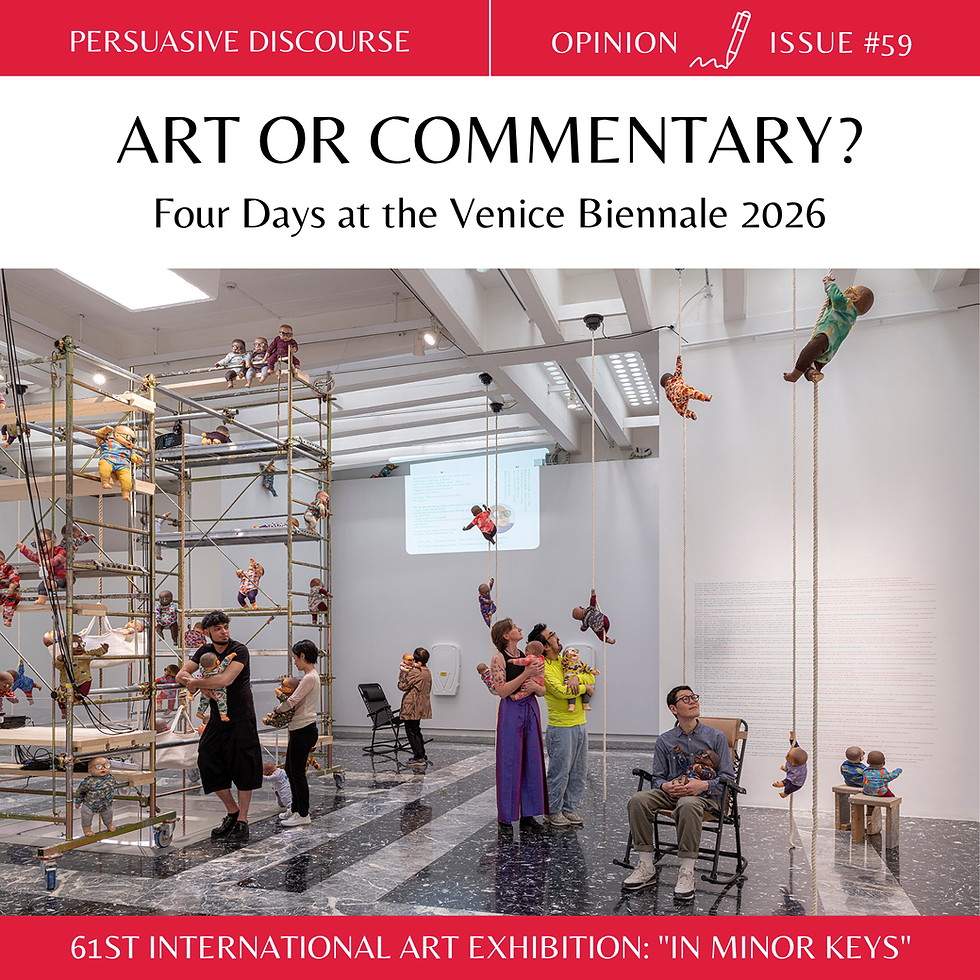
The Japan Pavilion presented one of the most quietly affecting experiences of my visit. Upon entering, each visitor was invited to pick up one of 200 baby dolls and carry it through the pavilion's pilotis, gardens, and interior spaces. The dolls were the size of newborns. Their weight felt realistic — unnervingly so.
I carried mine through the entire pavilion. Around me, fully grown adults did the same: cradling dolls, rocking them gently, sitting on swing benches as though finally at peace. Women held them with a tenderness that seemed to come from somewhere real. Children who accompanied their parents waited eagerly in line to receive a doll and walked through the space with the natural ease that adults, for some reason, had to work harder to find. At the end, visitors were invited to change the dolls' diapers — a small, absurd, intimate act — and scan a QR code to receive a "diaper poem" generated based on each baby's assigned birthday.
I left feeling sad in a way I had not anticipated. The exhibition was conceived by Japanese American queer artist Ei Arakawa-Nash, who became a parent in 2024, and it reflects on care as a form of labor — socially distributed, historically gendered, and increasingly fraught in a world of declining fertility rates and shifting social contracts. The walls of the pavilion carried information about these broader themes. But it was the weight of the doll in my arms — and the sight of adults performing care for a thing that could not receive it — that stayed with me longest.
Grass Babies, Moon Babies is co-curated by Horikawa Lisa, Senior Curator and Director (Curatorial and Collections) at the National Gallery Singapore, and Takahashi Mizuki, Executive Director and Chief Curator of the Centre for Heritage, Arts and Textile (CHAT) in Hong Kong. It is commissioned by the Japan Foundation.
II. The Self, the Screen, and the Prisoner: Taiwan
Screen Melancholy: Li Yi-Fan — Collateral Event, Palazzo delle Prigioni, Castello
I must note an important distinction: the Taiwan contribution is not a national pavilion but a Collateral Event — independently organised and presented at the Palazzo delle Prigioni, the former prison adjacent to the Doge's Palace, connected to it by the Bridge of Sighs. The contrast between the work and its setting was among the most striking experiences of my visit.
Entering the palace, I was confronted by a grotesque digital figure projected onto a large LED screen — a puppet-like character delivering a lecture about image-making, animation, game engines, pixels, and the nature of the self in a technology-saturated world. The figure was unsettling. Its words were simultaneously academic and mischievous, oscillating between tutorial and provocation. At one point, it referenced how Taiwan had once offered public phone-charging stations and how personal data had been stolen from them, repeating the word "disgusting" with a theatricality that felt both earnest and self-mocking.
But what struck me most was not the content — it was the feeling of recognition. The figure kept returning to the "I," the "eye," the self as the center of its own universe. In a former prison — a space historically designed to eliminate the individual's agency — an artwork was insisting on the primacy of individual experience, digital narcissism, and the flat screen as the defining aperture of contemporary life.
Scattered around the room were large 3D-printed sculptures: an oversized hand, a foot, a head, fragments of the digital performers enlarged to human scale. Visitors sat on them without thinking — the body sitting on a replica of itself, watching digital bodies perform. The boundaries between real and virtual dissolved completely. And the contrast between the Renaissance grandeur of the Palazzo delle Prigioni itself and the digital world unfolding inside it was a collision of past and present that felt entirely deliberate — and entirely appropriate.
I found it very hard to leave.
Li Yi-Fan was born in Taipei in 1989 and holds a master's degree in new media art from the National Taipei University of the Arts. He is currently artist-in-residence at the Rijksakademie in Amsterdam. The exhibition is curated by Raphael Fonseca, Curator and Head of Modern and Contemporary Latin American Art at the Denver Art Museum.
III. Water, Waste, and the Body as Monument: Austria
SEAWORLD VENICE — Florentina Holzinger — Austrian Pavilion, Giardini della Biennale
The line outside the Austrian Pavilion was long. We stood in the hot sun for approximately thirty minutes. I did not know what was inside. This, it turned out, was the correct way to arrive.
What drew the crowd even before entering was visible from the queue: outside the pavilion, a church bell stood at the entrance, held high by a truck, and a naked woman climbed inside it and became its clapper — her body replacing the traditional instrument, ringing out against metal in the heat. It was extraordinary marketing. It was also a precise conceptual statement: the female body as the mechanism of sacred time, replacing what had historically sounded without her.
Inside, the pavilion had been transformed into what its creator describes as an underwater amusement park, a sewage treatment plant, and a sacred building all in one. Entering, I turned left to find the first basin, in which a naked woman circled on a jet ski — a monument to the ecological catastrophe of turbo-tourism in a city already sinking. She passed close. I was splashed. I did not yet know what the water contained.
Advancing into an interior courtyard, a central tank came into view. Inside it, a performer lay as though sleeping — a direct citation of Giorgione's Sleeping Venus, the iconic Renaissance image of female repose. But here she was not silent and decorative; she was a biological survivor, sustained by waste. To either side of the tank stood two toilets where visitors were invited to donate urine — the only bodily fluid permitted, as signs made clear. The water processed from these donations fed the tank in which the performer lived. To my right as I faced the tank, a water processing unit was visibly struggling; it had apparently been blocked by a visitor who had not followed the instructions. Whether this was part of the performance or a genuine malfunction, I could not tell.
Turning to the right, the second basin contained a tall tree-like sculptural structure, up which another naked woman climbed during her performance slot. A giant weathervane pierced the architecture above. The performer in the water tank worked in shifts of approximately four hours. The full experience, if one stayed for the complete sequence of performances, apparently lasted around an hour.
It was overwhelming, deliberately so. It was also, once I understood its logic, extraordinarily coherent. Austrian choreographer and performance artist Florentina Holzinger — whose works have been selected four consecutive times by Theatertreffen Berlin — uses extreme physicality and theatrical precision to probe the limits of bodily agency. SEAWORLD VENICE asks what the female body is for, what water is for, what Venice is for, and what we leave behind. The metaphor of living in the waste of others, rendered literally and viscerally, is difficult to dismiss.
Curator: Nora-Swantje Almes.
IV. Weaving as Memory: Morocco
Asǝṭṭa — Amina Agueznay — Morocco National Pavilion, Sale dell'Artiglieria, Arsenale
Morocco's contribution to this year's Biennale is historically significant: it is the country's first official national pavilion. This fact alone merits attention. But the work itself earned it.
Amina Agueznay has spent over two decades working in close collaboration with Moroccan artisans and communities, weaving histories, gestures, and human relations into forms that activate memory and space. Asǝṭṭa — the Amazigh term for ritual weaving, a sacred feminine act in which the woven form is understood as a living being — unfolds as a living membrane suspended across the Sale dell'Artiglieria. The pieces breathed in the space allocated to them. Nothing felt crowded. Nothing felt placed.
I walked beneath the long tapestries and looked up at the details of the work from underneath. The colors — warm creams and burnt oranges — made me think of the Moroccan desert I had visited many years ago. The installation was organized as a threshold: neither inside nor outside, but a zone of passage. The Moroccan concept of âatba, meaning threshold, guided the spatial logic — a place where memory, ritual, and gesture converge. Standing beneath it, I found myself asking the same question I would carry through the rest of the Biennale: is this art? Is it craft? Is it something that exceeds both categories? For Morocco's first official national pavilion, it was a statement of remarkable calm and confidence.
Commissioner: Mohammed Benyaacoub. Curator: Meriem Berrada.
V. Home as a Thing That Can Be Destroyed: India
Geographies of Distance: Remembering Home — Five Artists — India Pavilion, Arsenale
India's pavilion was dedicated to the idea of home not as a fixed location but as a portable condition, continually remade in response to displacement, memory, and loss. Five artists gave form to this premise through ceramics, thread, organic materials, papier-mâché, and bamboo.
What struck me first were the enormous papier-mâché flowers overhead — large, white, orange and yellow, beautiful in the way of things that know they are temporary. To the opposite side, Sumakshi Singh's tapestry embroidery depicted a demolished family house, reconstructed in thread: home as a delicate structure sustained entirely by care and memory. Alwar Balasubramaniam's clay works registered the fragility of land — dried earth that made me think immediately of climate change, and of my own doctoral research on psychological distance and how we understand threats that feel far away until they are not. Bamboo structures by Asim Waqif — signaling the frantic growth of modern cities — invited visitors to sit inside the work, to rest inside the idea of displacement.
I stayed longer than I had planned. The pavilion touched something I had not expected to feel in a contemporary art exhibition: the specific sadness of a place you can no longer return to, and the human insistence on reconstructing it anyway.
Commissioner: National Gallery of Modern Art, Ministry of Culture. Curator: Amin Jaffer. Artists: Alwar Balasubramaniam, Sumakshi Singh, Ranjani Shettar, Asim Waqif, Skarma Sonam Tashi.
VI. Sand, Silver, and the Sound of Water: Oman
Zīnah (Adornment) — Haitham Al Busafi — Oman Pavilion, Arsenale Artiglierie
I had not known what to expect from the Oman pavilion. I left it as one of the most unexpectedly serene experiences of my entire visit.
Entering through a narrow, dimly lit threshold, I emerged into a circular space filled with sand sourced from the Omani desert. Above, a canopy of silver elements — abstracted from the forms of al-zaanah, the Omani tradition of adorning horses with silver — hung in delicate suspension. As visitors moved across the sand, the metal pieces shifted, striking each other gently, producing a continuous and evolving soundscape that somehow suggested water: waves, or rain, or the sound of something moving beneath the surface. The contrast with the heat outside was immediate and physical. The sand was fine and cool underfoot.
A toddler who had entered with her family immediately took off her shoes and began to play. The adults stood quietly. Nobody rushed.
The pavilion was conceived as an experience of mutual recognition — between horse and rider, between visitor and space, between desert and sea. A workshop held in Muscat had brought together students and emerging artists whose drawings were inscribed onto the metal elements, embedding multiple voices into the installation's structure. It was sensory, intimate, and quietly insistent — and in a Biennale full of urgency and confrontation, its stillness was its own kind of statement.
Artist and curator: Haitham Al Busafi. Commissioner: Ministry of Culture, Sports and Youth, Sultanate of Oman.
VII. Coexistence as a Contested Form: Switzerland
The Unfinished Business of Living Together — Swiss Pavilion, Giardini della Biennale
For readers of Persuasive Discourse, which is based in Switzerland, the Swiss Pavilion carries particular weight. I will admit that I walked through it quickly — not out of lack of interest, but because it made me uncomfortable. Which, I came to understand, was entirely the point.
The exhibition begins with an April 1978 episode of the Swiss public television programme Telearena, in which the so-called "problem of homosexuality" was debated publicly and controversially on live television — one of the first occasions when individuals identifying as homosexual gained a mainstream public voice in Switzerland. A 1984 follow-up on the francophone talk show Agora extended the conversation across Swiss, French, and Canadian audiences via satellite.
Inside, screens and video installations presented these archival debates and their contemporary extensions. The space felt, at moments, like a bunker — deliberately enclosed, deliberately pressurized. I felt goosebumps on my arms. The atmosphere was one of controlled unease, the kind that comes from recognizing yourself in a history you thought was safely past.
Homosexuality serves here, as the curatorial team notes, as "one historically specific entry point" into examining how social norms determine who can speak and be heard. The questions the pavilion raises are deliberately wider: from state security and surveillance to moral panics around the family, the exhibition shows how various forms of difference become perceived as threats to social order. Switzerland in 1978 feels, in this framing, not distant but uncomfortably close.
The Swiss Pavilion has stood in the Giardini since 1951–52, designed by architect Bruno Giacometti and owned by the Swiss Confederation. Pro Helvetia has been responsible for the Swiss contribution since 2012.
Curators: Gianmaria Andreetta and Luca Beeler. Artist: Nina Wakeford, in collaboration with Miriam Laura Leonardi, Lithic Alliance, and Yul Tomatala.
VIII. The Body in Grief: Nick Cave in the Arsenale
Two Points in Time — At Once — Nick Cave — Arsenale
Nick Cave — the American visual artist, not the musician — had work distributed across the Arsenale in what the Biennale describes as a processional path. His suite Two Points in Time — At Once comprises seven stages alluding to the stages of grief, moving from monumental bronzes to more intimate domestic materials: vintage metal serving trays, flowers painted on household objects, needlepoint self-portraits.
I encountered his sculptures across the Arsenale and near its entrance — large, extraordinary figures in which multiple human forms seemed to merge into one another, their bodies intertwined or overlapping, impossible to separate. The towering Amalgam (Origin) faces the Arsenale harbour, its body laced with intricate nature designs rising to a crown of branches, flowers, and birds. Inside the Corderie, bronzes depicted figures in positions of waiting, perishing, or rescue.
What struck me was that these works, unlike much of what I saw, felt less like argument and more like elegy. The forever flowers that spring from Cave's figures channel both remembering and joy. Grief, here, was not a political statement but a human one — and the distinction, in the context of this Biennale, felt important to note.
Cave was born in Chicago in 1959. Two Points in Time — At Once was supported by Jack Shainman Gallery, New York City, among others.
IX. One Person Among Many: Sawangwongse Yawnghwe
People's Desire — Sawangwongse Yawnghwe — Central Pavilion — Arsenale
I was not expecting to be as moved as I was by the work of Sawangwongse Yawnghwe, a Burmese artist born in 1971 in Shan State and now living between Zutphen in the Netherlands and Chiang Mai in Thailand.
People's Desire (2018) is a six-metre-long installation of 2,500 crudely modelled clay figurines — families among them — walking or floating in boats in a mass exodus. The artist named the Rohingya massacres as genocidal as early as 2014, connecting them to the Karen, Kachin, and Shan peoples stripped of their land and resources under military rule in what has become the longest civil war in contemporary history.
Standing in front of it, I thought: this is one person among many. And then: I am one person among many. The scale of the work — 2,500 individual figures, each roughly made, each carrying its own implicit story — produced a feeling that no statistic about mass displacement could replicate. History rendered in clay. Each tiny figure a life.
X. The Breath Beneath the Surface: South Korea
Breath Orchestra — Yo-E Ryou — Arsenale
In the Arsenale, the work of Seoul-based artist Yo-E Ryou offered one of the most immersive sound experiences of my visit. Breath Orchestra draws on Ryou's time living among the haenyeo — the women of Jeju Island who continue a tradition of diving ten metres deep or more without oxygen assistance to gather food from the sea.
The multi-channel sound installation fills the space with four distinct breaths: the regulating breath that prepares the body to dive; the powerful breath that fuels the descent; the long, submerged breath of labour; and the recovery breath on surfacing, sometimes repeated twenty or more times. Seating references the bulteok, the open-air enclosures where haenyeo gather. Video works showed the women sleeping close together — the intimacy of people who share extreme physical labor and mutual dependence. Images of children suggested continuity, the transmission of an ancient practice across generations.
I sat contemplating the work for longer than I intended. The installation reminded me, quietly and insistently, that survival is sometimes a matter of learning to breathe — and to listen — again.
Ryou was born in Seoul in 1987 and lives between Seoul and Jeju Island.
XI. The Hidden, the Discarded, and the Posthumous: The Bahamas
In Another Man's Yard — John Beadle and Lavar Munroe — Bahamas Pavilion, San Trovaso Art Space, Dorsoduro 947
One of the most unexpected discoveries of my visit was the Bahamas Pavilion, housed not in the Giardini or Arsenale but in a space scattered across the city — the San Trovaso Art Space in Dorsoduro, free to enter. It marked the second presentation of The Bahamas at the Venice Biennale, following a thirteen-year absence.
The exhibition is an intergenerational dialogue between two Bahamian artists: John Beadle (1964–2024), who died the year before the Biennale opened, and Lavar Munroe (b. 1982). Both are grounded in the visual and social traditions of The Bahamas and the broader African diaspora, and both worked at the intersection of contemporary art and Junkanoo — the centuries-old biannual processional festival that Beadle described as "the cultural bedrock of The Bahamas."
Inside, life-sized human figures constructed from discarded materials stood and hung across the space. The faces were astonishingly realistic — and yet their clothing, their surfaces, their very substance was assembled from cardboard, cast-off Junkanoo costumes, abandoned parade materials. In one room, machetes hung from the ceiling above a painting. The combination produced a feeling I can only describe as grief inflected with beauty: the objects of daily labor suspended above an image of daily life, the violence latent in both.
In a city famous for its February carnival — where masks and costumes define the public face of festivity — the Junkanoo tradition resonated with particular clarity. Beadle's use of discarded cardboard, the concealed inner structure of Junkanoo costumes, drew attention to what is hidden beneath the spectacle: the labor, the materials, the people and processes typically rendered invisible.
The centerpiece of Munroe's contribution is No Matter How Dreary and Gray, We People of Flesh and Blood Would Rather Live Here, Than in Another Man's Yard (2026), an eleven-panel monumental painting depicting a memorial procession in honor of Beadle himself. The exhibition also features posthumous collaborative works in which Munroe incorporated materials recovered from Beadle's studio after his passing — a practice he had begun with his late father, using materials related to his father's profession as a parasail operator.
The exhibition is curated by Dr. Krista Thompson and resonates directly with Koyo Kouoh's curatorial vision: artists who foreground the hidden, the undervalued, the minor keys of society and of the art world itself.
Commissioner: John Cox.
XII. What Contemporary Art Looks Like for Italy and the United States
Con te con tutto — Chiara Camoni — Italian Pavilion, Arsenale Call Me the Breeze — Alma Allen — United States Pavilion, Giardini
After hours in the Arsenale absorbing political weight, ecological dread, and social urgency, two exhibitions offered something different: the quiet pleasure of form for its own sake.
The Italian Pavilion opened onto a dimly lit space populated by twenty-four anthropomorphic sculptures — Colonne, Sisters and Daimons — shaped from coiled clay or composed of small terracotta elements, each figure in a state of potential metamorphosis. Standing and walking among them felt like walking among minor deities — my own size, their colors earthy and muted, the theatrical lighting making them glow. I thought of mannequins on a runway, of coral reefs that have died but remain standing, of people who have passed but remain present in memory. The space felt theatrical, even cinematic — visitors moved among the figures like participants in a slow, silent procession.
Chiara Camoni's practice is rooted in ceramics and in the idea of encounter — with other forms of life, with other materials, with time. In the context of this Biennale, it read as a quiet refusal of despair.
At the United States Pavilion in the Giardini, sculptor Alma Allen presented Call Me the Breeze — large biomorphic sculptures in bronze, marble, parota wood, obsidian, and volcanic rock, each one appearing to be in the act of leaving, or rising, or reaching toward something invisible. Allen was born in Salt Lake City in 1970 and is largely self-taught; his sculptures carry the energy of the natural landscapes that have shaped his life: Utah, Joshua Tree, Tepoztlán in Mexico. The materials are all sourced from the Americas. The white Colorado Yule marble used in several pieces is the same stone used for the Lincoln Memorial and the Tomb of the Unknown Soldier.
In the context of the 250th anniversary of the United States — America250 — the pavilion's emphasis on elevation, weightlessness, and collective optimism read as a deliberate counterpoint to the anxieties dominating much of this Biennale. Whether that was the right artistic choice, I leave to others more qualified to judge.
Commissioner: Jenni Parido. Curator: Jeffrey Uslip.
XIII. Art That Enters the Body: Marina Abramović
Transforming Energy — Marina Abramović — Gallerie dell'Accademia di Venezia, 6 May – 19 October 2026
Running concurrently with the Biennale — though not officially part of it — was Transforming Energy, a major solo exhibition by Marina Abramović at the Gallerie dell'Accademia di Venezia. Abramović, who turns 80 this year, became the first living woman artist to be honoured with a major exhibition at the Accademia. The show, curated by Shai Baitel, Artistic Director of the Modern Art Museum (MAM) Shanghai, placed her performance works — including iconic pieces such as Imponderabilia (1977) and Rhythm 0 (1974) — in direct dialogue with Renaissance masterpieces held in the museum's permanent collection.
I went. And I was not prepared for what I felt inside.
The exhibition moved through the body rather than past it. A doorframe constructed of crystal offered a threshold to pass through; I walked through it slowly and felt the light of the crystals on my skin. In another room, three wooden pieces were placed in the shape of a tent or protective structure, crystals pointing inward — standing beneath it felt like standing inside a shelter built specifically for one person. Three crystal structures attached to the walls, calibrated to different heights, invited visitors to lean their foreheads, chests, or pelvic areas against the cold stone. I placed my forehead on the crystal and felt the coolness travel through me. I held it there longer than I expected to.
I lay down on one of Abramović's wooden beds, my head positioned beneath a large crystal, wearing the noise-cancelling headset provided by the gallery. The room was dimly lit. The bed was hard, yet I have never felt so relaxed in an exhibition space in my life, and I am still slightly confused by this.
A life-size projection of Abramović herself appeared on a wall — walking, almost as a hologram, her presence filling the room. And then the most extraordinary moment: a wall covered in long, black ponytails, each strand almost reaching to the floor. Wearing the noise-cancelling headset, I pressed my back against the wall, and a sensor activated the hair — it moved, vibrated, and cascaded against my back from shoulders to legs. It was bizarre. It was ticklish. It was, unexpectedly, funny.
What Abramović achieved, across every room, was the dissolution of the boundary between art and body. I walked through her work, leaned against it, lay inside it, let it touch me. By the time I encountered the Pietà (with Ulay) (1983), placed in direct dialogue with Titian's own unfinished Pietà (c. 1575–76) on the 450th anniversary of Titian's death, I understood what endurance in art can mean — not as suffering for its own sake, but as presence, sustained and given.
When I visited the Austrian Pavilion afterwards, the connection between the two became clear to me: body as shape and body as self; body as seen and perceived by the other; body as impacting the world — whether through care and transformation, as in Abramović's work, or through confrontation and waste, as in Holzinger's. Two radically different approaches to the same question.
This exhibition is not to be missed if you are in Venice before October 19, 2026.
Conclusion: Art or Commentary?
I came to Venice expecting art. I found something harder to name.
What the 61st Biennale makes clear, across pavilion after pavilion, is that for many of the world's most significant contemporary artists, the distinction between art and social commentary has collapsed — or was perhaps never as stable as we assumed. The female body as a site of ecological and political resistance (Austria). Caregiving as a gendered and historically fraught form of labor (Japan). The self in a world of digital images (Taiwan). Displacement, home, and memory (India, Morocco). Grief, exodus, survival (Nick Cave, Sawangwongse Yawnghwe). The hidden labor behind spectacle (The Bahamas). Coexistence as a problem that remains unsolved (Switzerland). The breath of women who dive without oxygen (South Korea). The body as a site of transformation and rest (Marina Abramović).
This is not art that stands apart from the world and invites contemplation. This is art that insists the world is already inside the gallery, has always been inside the gallery, and that looking at it clearly — without flinching — is itself a political and moral act.
I am not a trained artist. My background is in international relations, communications, and persuasion, and it is through those lenses that I have written this piece. I make no claim to evaluate the craft of what I saw. What I can say, as someone who has spent a career thinking about how human beings communicate across difference, is that the Venice Biennale 2026 is a remarkably coherent act of communication about the world we inhabit.
Koyo Kouoh called artists "vital interpreters of the social and psychic condition." Standing at the Arsenale entrance, beneath a poem by a poet killed in Gaza, I understood what she meant. Whether that makes this art or commentary may be the wrong question entirely.
The Biennale Arte 2026 runs until November 22, 2026. If you go — and you should go — bring water, sunscreen, and the most comfortable shoes you own. And be prepared to leave with more questions than you arrived with.
Note: The Venice Biennale 2026 covers an enormous physical and conceptual space. This commentary reflects what one visitor was able to see on foot across the Arsenale, the Giardini, and various locations throughout Venice between June 17 and June 20, 2026. It is not a representative survey of all 110 participating artists. For a complete list of participants and locations, visit www.labiennale.org.
Image credit: Ei Arakawa-Nash, Grass Babies, Moon Babies. Installation view at the Japan Pavilion, The 61st International Art Exhibition of La Biennale di Venezia (2026). Photo: Uli Holz. Courtesy of The Japan Foundation.
References
Al-Areer, R. (2024). If I must die: Poetry and prose. OR Books.
American Arts Conservancy. (2026). Alma Allen: Call Me the Breeze. US Pavilion, 61st International Art Exhibition of La Biennale di Venezia. https://www.almaallenvenice2026.org/
Art Africa Magazine. (2026, May 1). Zīnah (Adornment): Oman's Pavilion tunes the Biennale to resonance over spectacle. Art Africa Magazine. https://artafricamagazine.org/zinah-adornment-omans-pavilion-tunes-the-biennale-to-resonance-over-spectacle/
Art Africa Magazine. (2026, April 29). In Minor Keys: The 61st Biennale di Arte Venezia opens under Koyo Kouoh (1967–2025). Art Africa Magazine. https://artafricamagazine.org/in-minor-keys-the-61st-biennale-di-arte-venezia-opens-under-koyo-kouoh-1967-2025/
E-flux. (2026, May 14). Chiara Camoni: Con te con tutto. Italian Pavilion at the Venice Biennale. E-flux Announcements. https://www.e-flux.com/announcements/6787197/chiara-camonicon-te-con-tutto
E-flux. (2026, May 4). In Another Man's Yard: John Beadle, Lavar Munroe, and the Spirit of (Posthumous) Collaboration. E-flux Announcements. https://www.e-flux.com/announcements/6785611/in-another-man-s-yard
Holzinger, F. (2026). SEAWORLD VENICE: Austrian Pavilion, Biennale Arte 2026. https://www.seaworldvenice.at/
Japan Foundation. (2026). Grass Babies, Moon Babies: Ei Arakawa-Nash, Japan Pavilion, 61st International Art Exhibition. Japan Foundation. https://venezia-biennale-japan.jpf.go.jp/e/art/2026-en
Japan Foundation. (2026, March 19). Press release no. 2025-070e: Ei Arakawa-Nash's Grass Babies, Moon Babies. Japan Foundation. https://venezia-biennale-japan.jpf.go.jp/wp/wp-content/uploads/2026/03/2025-070e.pdf
La Biennale di Venezia. (2026). In Minor Keys: 61st International Art Exhibition. La Biennale di Venezia. https://www.labiennale.org/en/art/2026
La Biennale di Venezia. (2026). Bahamas (The): In Another Man's Yard. https://www.labiennale.org/en/art/2026/bahamas
La Biennale di Venezia. (2026). India: Geographies of Distance: Remembering Home. https://www.labiennale.org/en/art/2026/india
La Biennale di Venezia. (2026). Morocco (Kingdom of): Asǝṭṭa. https://www.labiennale.org/en/art/2026/morocco-kingdom
La Biennale di Venezia. (2026). Nick Cave: Two Points in Time — At Once. https://www.labiennale.org/en/art/2026/nick-cave
La Biennale di Venezia. (2026). Sawangwongse Yawnghwe. https://www.labiennale.org/en/art/2026/sawangwongse-yawnghwe
La Biennale di Venezia. (2026). Yo-E Ryou: Breath Orchestra. https://www.labiennale.org/en/art/2026/yo-e-ryou
Lawson-Tancred, J. (2026, April 13). A data analysis of the 2026 Venice Biennale signals a shift to the present. Artnet News. https://news.artnet.com/art-world/venice-biennale-2026-data-analysis-2754880
Lisson Gallery. (2026). Marina Abramović: Transforming Energy. Gallerie dell'Accademia di Venezia, 6 May – 19 October 2026. https://www.lissongallery.com/exhibitions/venice-2026/artwork/venice-2026-marina-abramovic-at-gallerie-dell-accademia-di-venezia
Okri, B. (2017, December/2018, January 4). The unknown hour. New Statesman, pp. 28–29.
Pro Helvetia. (2026, January 22). The Swiss Pavilion at the 61st International Art Exhibition – La Biennale di Venezia 2026. https://prohelvetia.ch/en/whats-on/the-swiss-pavilion-at-the-61st-international-art-exhibition-la-biennale-di-venezia-2026-3/
Taiwan in Venice. (2026). Screen Melancholy: Li Yi-Fan. https://www.taiwaninvenice.org/2026/
***
Sorina I. Crisan - Matthey de l'Endroit, PhD is the founder of Persuasive Discourse and the creator and host of The Persuasive Mindset podcast. She holds a PhD in International Relations, with a focus on Communications, from the Graduate Institute of International and Development Studies, Geneva, and lectures at the Lemanic Neuroscience Doctoral School at the University of Geneva and the University of Lausanne. Her work focuses on persuasion, communication, and the intersection of knowledge and public life. Photo credit: Ana Claudia Calabria.


Comments